
Innovative flooring for superior acoustic isolation
The wood floating floor system is a modern solution that creates an effective air cavity ranging from 25 mm to 100 mm. Our design incorporates an advanced resilient isolator that ensures outstanding acoustic performance.
Design possibilities
Adaptable to different load requirements
The system can be engineered to meet any structural load demands.
Easy creation of air cavities
Air spaces can be designed at 25 mm, 50 mm, 75 mm, or 100 mm.
Fast and cost-effective installation
The installation process is straightforward, efficient, and economical.
Optional channels or nailers
These can be used to increase stiffness and extend the air cavity.
Applications
Auditoriums
Lecture halls
Performance and rehearsal spaces
Critical acoustic environments
Recording studios
Home theaters
Product details.
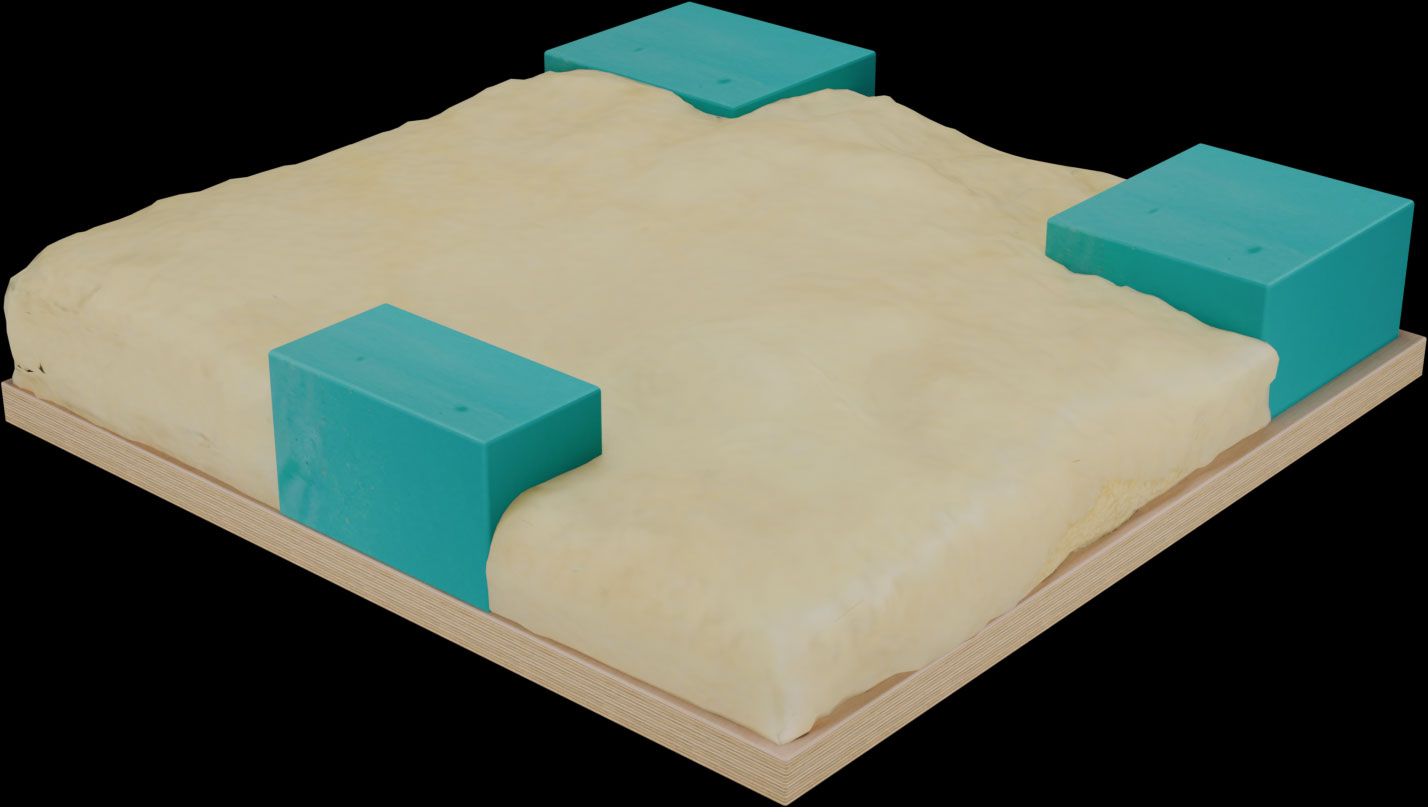
Applications
As a flagship system of Kinetics Noise Control, the acoustic wood floating floor adapts to all design requirements. Equipped with Model KIP isolators—carefully selected and arranged according to precise criteria—our system offers significant advantages compared to traditional solutions.
By using pre-spaced isolators, installation becomes simpler and faster—eliminating the need for complex measurements and individual mount placement. This innovative installation method not only saves time but also ensures a high-quality floor with excellent acoustic properties.
In addition, our flooring system has been designed with key requirements in mind, such as load capacity, natural frequency/deflection of the isolator, and superior acoustic performance.
Choose the acoustic floating floor system and enjoy comfort and silence that transform your interior into a space of harmony!
Installation
Installation of the RIM wood floating floor system is similar to that of an isolated concrete slab. The process begins with preparing a level base floor and applying a 10 mm SRP perimeter isolation strip (height depends on the final floor height). Rolls of fiberglass with pre-attached isolators are then laid in the proper locations.
Where large point loads are expected, individual KIP isolators are placed according to drawings provided by us. Typically, two layers of 18 mm plywood (with staggered joints) are installed on the isolation mounts, and the finished floor is assembled according to manufacturer instructions.
Although two layers of 18 mm plywood are usually sufficient for most types of isolated wood floors, three layers—glued and screwed together—can be used to increase stiffness and mass, which improves load distribution and noise control. For comparison, see sound test results AT001035 vs. AT001036 to observe how added mass affects STC performance.
At the end of installation, an acoustic sealant should be applied to the top of the SRP strip to ensure complete acoustic tightness.
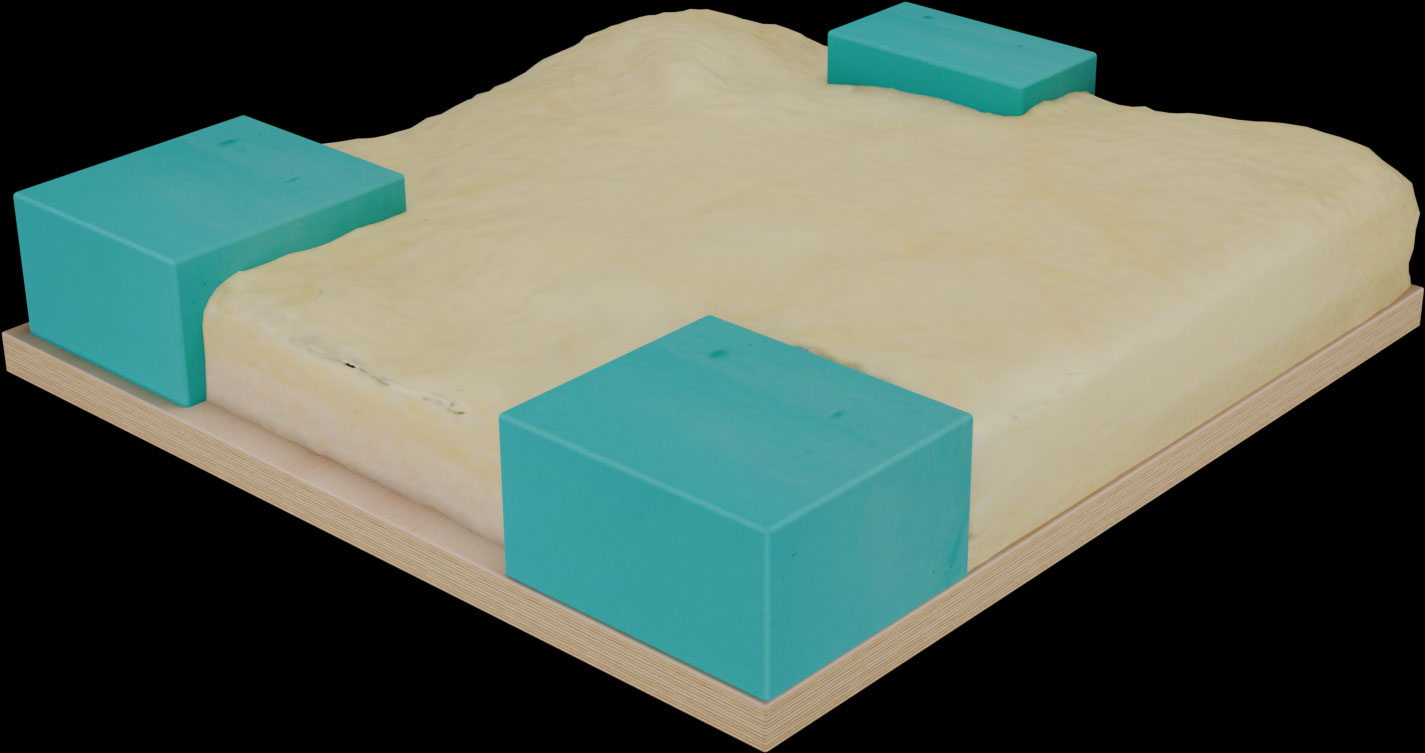
RIM wood floating floor
The RIM acoustic wood floating floor system is ideal for dance studios, loft-style apartments, recording studios, and other spaces where high performance in noise control must be combined with a low profile and lightweight construction. The RIM system outperforms continuous underlayments thanks to its air cavity and lower natural frequency, achieved by spacing KIP isolators at 300 mm, 400 mm, or 600 mm intervals.
The RIM system can be tailored to different load conditions. However, note that in cases of free-weight drops (as in fitness centers), lightweight composite floors may not be sufficient under impact loads. Depending on the severity of the impacts, damage to lightweight flooring and isolators may occur.
We recommend consulting with Quiet Solution during the design phase of such projects to ensure optimal solutions tailored to specific requirements.